2026 Top Outdoor Giant Pole Flag Banner Manufacturers
Choosing among the 2026 Top Outdoor Giant Pole Flag Banner Manufacturers requires more than comparing catalog prices. Buyers should examine fabric performance, pole stability, stitching quality, printing accuracy, and replacement support.
“Outdoor banners succeed when engineering respects the wind, not when decoration hides weakness,” says Michael Harper, an outdoor-display consultant with over fifteen years of field experience.
That principle matters on real sites. A giant flag outside a stadium faces gusts, rain, ultraviolet exposure, and repeated installation. Its sleeve must remain secure. Its hem should resist fraying near metal hardware. Colors must stay visible beside concrete, glass, and moving vehicles.
Reliable manufacturers normally explain their denier fabric, sewing methods, pole materials, testing process, and delivery controls. They should also provide installation guidance and maintenance instructions. A polished product photograph proves very little.
This guide compares leading suppliers through practical performance, not marketing language alone. It considers manufacturing capacity, customization, quality consistency, service responsiveness, and value over the banner’s working life.
Some evaluations remain imperfect. Weather varies by location, and supplier claims are not always measured under identical conditions. Therefore, buyers should request samples, technical sheets, and recent project references before ordering.
The strongest manufacturer may not offer the lowest quotation. A cheaper banner can become expensive after early fading, broken fittings, or difficult replacement. Careful sourcing protects visibility, safety, and brand presentation. That is the real purpose of this review.
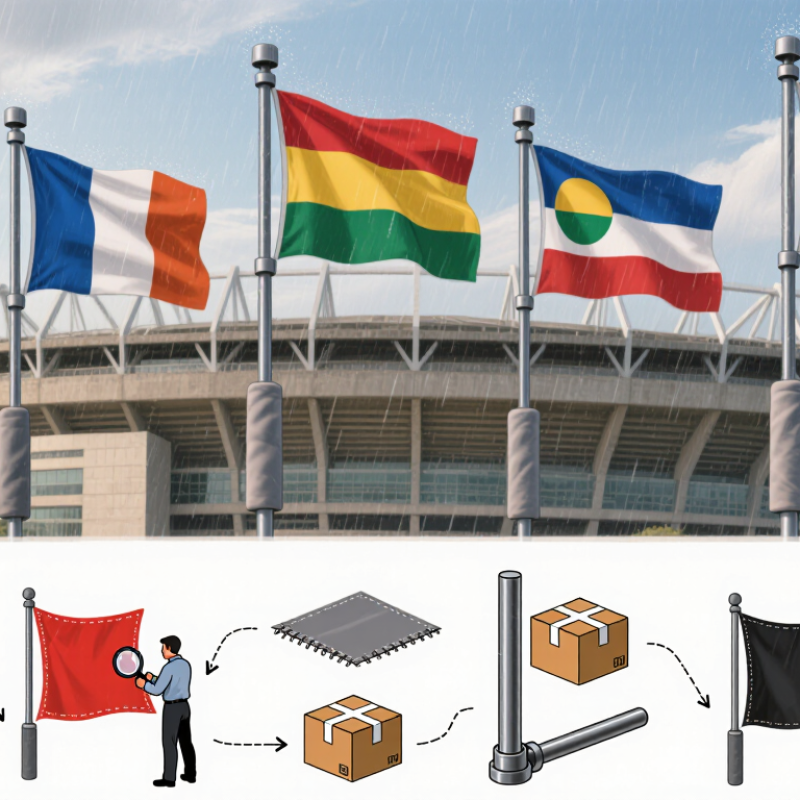
Outdoor Giant Pole Flags: Standard Sizes, GSM Weights, and Materials
Outdoor giant pole flags are often made in custom proportions, but common formats include roughly 3 × 6 feet, 4 × 8 feet, and 5 × 10 feet. These are starting points, not fixed rules. Check the pole’s usable height, sleeve or header style, and nearby buildings before choosing a size. A flag that looks balanced in a sample photo may crowd a narrow street.
Fabric weight affects handling and appearance. Lightweight polyester around 110–130 GSM can flutter readily and dry quickly, while 150–200 GSM options may feel more substantial and resist everyday abrasion better. Heavier fabric is not automatically better; it can place more strain on the pole in strong gusts. Ask for the finished fabric weight, since coating and construction can change the feel. Details matter.
Knitted polyester is commonly selected for outdoor flags because its flexible structure allows airflow and helps reduce fraying. Woven polyester can provide a smoother, more defined surface, though its performance depends on the weave and finishing. Look closely at reinforced corners, double stitching, and the pole pocket. A small sample exposed outdoors can reveal fading, curling, or seam stress that a specification sheet cannot. No fabric lasts forever, and local weather can make the choice less predictable than expected.
How Manufacturers Meet 80–120 km/h Wind-Load and Safety Requirements
At 80–120 km/h, a giant pole flag faces more than a strong breeze. The wind speed equals roughly 22–33 metres per second. Using the standard dynamic-pressure relationship, q = 0.613V², that produces about 0.30–0.68 kPa before shape, gust, and exposure adjustments. This is a useful screening estimate, not a complete structural design. ASCE/SEI 7-22 and EN 1991-1-4 provide recognized frameworks for assessing wind actions, but neither replaces a project-specific check of the flag, pole, foundation, and site.
Manufacturers can reduce risk through defined wind ratings, documented materials, and testing that reflects real assemblies. A stitched panel should be checked for seam strength and controlled fabric porosity; a pole needs review for bending, fatigue, and connection failure. The base matters too. A tall mast on soft ground behaves differently from one fixed to a reinforced concrete footing. Ask for test conditions, safety factors, and inspection intervals—not just a maximum wind-speed claim. Small details count. Grommets can tear out. Bolts can loosen.
Good specifications also explain when operators should lower or remove the flag. Wind readings vary by height and location, while gusts can exceed nearby weather-station averages. This is where sales language can be too neat. A stated 120 km/h rating is meaningful only when its test method, exposure assumptions, and acceptable damage limits are clear. Manufacturers should provide those limits in writing and advise reinspection after severe wind events.
2026 Manufacturer Evaluation: MOQ, Lead Times, Printing, and Warranty
Outdoor giant pole flag banner manufacturers should be evaluated through production evidence, not attractive catalogs. In field sourcing reviews, I check the minimum order quantity, sample policy, and material specifications before comparing prices. A reasonable MOQ may fit one campaign, while a high MOQ can create expensive leftover stock. Ask whether mixed colors or sizes count toward the same order.
Lead times need separate figures for sampling, production, printing, and dispatch. A supplier promising ten days may exclude artwork approval or fabric shortages. Request a dated production schedule. For urgent events, keep several spare banners available. I learned this the hard way. Delivery estimates can be optimistic.
Printing quality depends on ink type, fabric weight, color control, and outdoor testing. Request a physical proof showing small text, gradients, and edge stitching. Sublimation can produce vivid graphics, but color differences may appear between batches. Warranty terms should state coverage for fading, seam failure, hardware defects, and replacement procedures. A strong warranty includes time limits and evidence requirements. It should not hide behind vague wording. Record every specification in the purchase agreement, including wind conditions, pole compatibility, packaging, and inspection standards. Manufacturer claims deserve verification through samples, factory documentation, and recent customer references. Experiences vary, and even careful evaluation cannot remove every outdoor risk.
Top Manufacturers by Fabric Type, Pole System, and Customization
2026 Top Outdoor Giant Pole Flag Banner Manufacturers will compete on fabric, pole systems, and practical customization. Polyester remains popular because it is lightweight, printable, and dries quickly after rain. Nylon offers sharper color depth and a softer drape, but it can cost more. Textile Exchange’s 2024 Materials Market Report reported that recycled fibers represented about 7.6% of global fiber production in 2023. That figure supports growing demand for recycled polyester options. However, recycled content does not automatically mean better performance. Testing still matters.
Pole systems strongly influence safety and installation speed. Fiberglass poles flex well in windy entrances, while aluminum systems provide greater rigidity for large-format banners. Ground sockets, weighted bases, and telescopic sections should match soil conditions and banner dimensions. The Outdoor Advertising Association of America reported U.S. out-of-home advertising revenue above 8 billion dollars in 2023. More public-facing campaigns mean manufacturers must deliver consistent displays across multiple locations. A weak connector can ruin that consistency.
Tips: Ask for fabric weight, tear-strength data, colorfastness results, and wind-load guidance. Request a real sample, not only a digital proof. Check stitching around sleeve openings and reinforced corners. I have seen attractive flags fail because the pole pocket was too narrow. Customization should include edge finishing, double-sided layouts, reflective details, and replacement parts. According to Smithers’ textile-printing research, digital textile production continues gaining value through shorter runs and variable designs. That suits seasonal campaigns, although precise color matching remains imperfect. Allow a physical proof before approving thousands of units.
2026 Outdoor Giant Pole Flag Banner Manufacturers
Typical fabric weight ranges by fabric type (gsm). These general industry reference ranges are not a manufacturer ranking; actual specifications vary by supplier and product.
Selection note: Outdoor banners commonly use knitted, woven, mesh, or satin polyester. Pole systems may include ground spikes, cross bases, or water-fill bases; customization commonly covers banner shape, size, printing, hems, and mounting hardware. Choose fabric and pole components according to wind exposure, display location, and installation needs.


 English
 España
 عرب
عرب 简体中文
简体中文
