
7 Trampoline Mat Buying Tips for Global Buyers

A trampoline can look ready for shipment while its mat hides weak stitching, poor fit, or limited weather resistance. For global buyers, those details affect safety, product life, returns, and supplier relationships. The Trampoline Mat deserves careful review, not a quick comparison of prices.

Grand View Research estimated the global trampoline market at USD 3.2 billion in 2022 and projected a 4.6% compound annual growth rate from 2023 to 2030. This market estimate suggests sustained demand, but it does not verify any particular mat’s quality. Small parts matter. Buyers should check fabric composition, UV-resistance claims, stitch density, edge reinforcement, dimensions, and spring-attachment layout. Ask suppliers for supporting test documents and clear product specifications. A polished sample is useful, but it cannot replace consistent production checks.

The seven buying tips ahead focus on practical questions: Will the mat fit the frame precisely? Can the supplier explain its material and load-rating data? Are sample inspections and packaging details documented? These checks help buyers compare offers across markets without relying on vague claims. Some specifications may still be difficult to compare between suppliers. That is easy to miss. Treat that uncertainty as a reason to ask for clarification, not as proof of poor quality. A careful purchasing process starts with measurable details and leaves room to reassess assumptions.
7 Trampoline Mat Buying Tips for Global Buyers

Understanding Trampoline Mat Types and Intended Uses

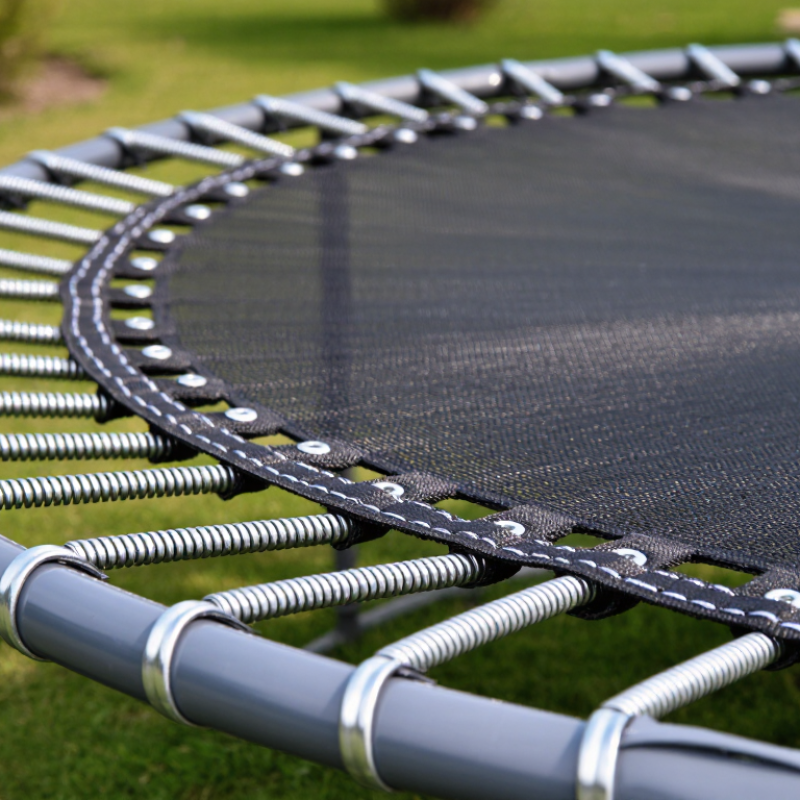
A trampoline mat is more than a black jumping surface. Its material, weave, and attachment points should match the frame and the way the trampoline will be used. Most recreational mats use woven polypropylene, valued for its balance of flexibility and durability. For outdoor installations, ask whether the fabric has UV protection; direct sun can weaken fibers over time. Small detail, big difference.

Light backyard use and frequent commercial use place different demands on a mat. A heavier weave or reinforced stitching may suit higher use, but it does not make an incompatible mat safe. Check the trampoline’s frame diameter, spring count, spring length, and number of mat attachment points against the supplier’s specifications. Measure carefully. A few mismatched centimeters can leave uneven tension or prevent secure fitting.

Some systems use springless designs with elastic rods or other connectors. Their mats are made for that specific structure, not for a conventional spring frame. For wet or exposed locations, consider drainage and material weather resistance, then inspect seams and loops for wear during routine checks. Specs can look reassuring on paper. I would still verify the intended use and replacement fit before ordering; product listings sometimes leave details unclear.

Matching Mat Dimensions and Attachment Points to the Frame

For a replacement trampoline mat, match the frame—not just the advertised diameter. Measure the frame across its outer edge, then check the mat’s usable diameter and the number of attachment points. A few centimeters of mismatch can leave the mat slack or pull the springs at an angle. Count every spring and compare the spacing between attachment points around the frame. Small differences matter.

CPSC’s 2018 trampoline injury report, based on NEISS emergency-department data, estimated 116,800 trampoline-related injuries treated in U.S. emergency departments. The figure does not show that a poorly matched mat caused those injuries, but it underlines why fit deserves careful checking.

For a cross-check, review the current ASTM F381 consumer-trampoline safety specification and the frame maker’s measurement guidance. Check ring shape, spring length, and whether the mat’s attachment loops sit evenly when installed.

No forced stretching. If dimensions seem close but not exact, pause and verify them; product listings may round measurements, and I would not treat a rounded size as confirmation.

A millimeter-by-millimeter map is rarely practical, but a written count and two diameter measurements can prevent an expensive mismatch.

Evaluating Fabric Strength, Stitching, UV Resistance, and Capacity

For global buyers, a trampoline mat should be judged by test evidence, not fabric weight alone. Ask for the fabric’s breaking-strength results under ASTM D5034, which measures textile strength using a grab test. Compare samples from the same material and test method; results from different methods may not be directly comparable.

Inspect the underside, too. Even stitching, reinforced edge webbing, and cleanly finished holes reduce visible weak points. One loose seam matters.

Sunlight is harder to assess by eye. ASTM G154’s commonly used Cycle 1 exposes samples to eight hours of UVA at 60°C, followed by four hours of condensation at 50°C. This is a controlled comparison, not a promise of years outdoors. Request the exposure duration and post-test strength or color-retention results.

For capacity, check the supplier’s stated user-weight limit and how it was verified; do not infer capacity from fabric thickness. Ask whether the rating applies to one user or combined weight. A tidy specification sheet helps, but I would still inspect a physical sample: small inconsistencies can hide at the stitching.

Verifying Safety Compliance and Supplier Quality Controls

7 Trampoline Mat Buying Tips for Global Buyers

Verifying Safety Compliance and Supplier Quality Controls

A trampoline mat can look sturdy while hiding weak stitching or inconsistent attachment points. Ask suppliers for test reports tied to the exact mat design and materials you plan to buy. Check the test method, sample size, date, and acceptance criteria. Paper can look convincing. Confirm that the reports address the requirements of your destination market, and verify them with the issuing laboratory when possible.

Inspect more than certificates. Request close-up photos of reinforced edges, stitching, and spring attachment areas, plus records for fabric and thread batches. Ask how workers check seam spacing and reject damaged materials. A useful supplier can explain the process, not just send a polished document. Compare a production sample with the approved sample, then check dimensions and attachment positions yourself. Small differences matter.

Quality controls should continue after the first order. Ask how the supplier records defects, handles corrective actions, and traces each shipment to its production batch. If possible, arrange an independent pre-shipment inspection using clear pass-or-fail criteria. No checklist catches everything; that is uncomfortable but true. Revisit the controls when materials, factories, or construction details change, and keep written records of what was verified.

7 Trampoline Mat Buying Tips for Global Buyers - Verifying Safety Compliance and Supplier Quality Controls

Buying Tip What to Check Evidence to Request Why It Matters
1. Confirm the destination-market requirements Identify the product type, intended users, sales region, and applicable trampoline safety requirements before placing an order. Requirements can differ by market and product category. A written compliance plan listing the applicable standards and regulations, plus test reports for the relevant finished product and model. A report for a different product type or market may not demonstrate compliance for the item being imported.
2. Verify the scope and authenticity of test reports Check that the report identifies the exact model or construction, test methods, results, test date, and issuing laboratory. Confirm that the laboratory is appropriately accredited for the tests performed. The complete report, laboratory accreditation details, and confirmation that the tested sample matches the production specification. A certificate or summary page alone may not show what was tested or whether the results apply to the ordered mat.
3. Match mat dimensions to the frame Specify the frame diameter or shape, spring count and length, attachment-point count, and mat dimensions. Confirm fit using a production sample, not dimensions alone. A controlled drawing with tolerances, a measurement record, and a fit-check report for the intended frame configuration. A mat that is too large, too small, or has misplaced attachment points may fit poorly and affect safe use.
4. Assess fabric and outdoor durability Review the fabric type, coating or UV-stabilization details, seam construction, and intended indoor or outdoor use. Request durability data relevant to the actual material and design. Material specification, supplier change-control records, and applicable test results for weathering, tensile strength, or seam strength. Sunlight, moisture, and repeated use can contribute to material degradation; a material name alone does not establish service life.
5. Inspect attachment points and stitching Check the number, spacing, reinforcement, and finish of attachment points. Inspect stitching for consistency, loose threads, skipped stitches, and visible damage. Approved construction samples, inspection criteria, process checks, and test records for relevant seams and attachment areas. These areas transfer repeated loads, so inconsistent workmanship can contribute to premature failure.
6. Audit production quality controls Review incoming-material checks, in-process inspections, final inspection, nonconformance handling, and corrective-action procedures. Treat a quality-system certificate as evidence of a management system, not proof that a product is compliant. Quality-control procedures, recent inspection records, calibration records where applicable, and relevant corrective-action examples. A documented system helps assess production consistency, but it does not replace product-specific safety testing.
7. Set acceptance criteria and traceability before shipment Agree on inspection criteria, sampling approach, defect definitions, packaging requirements, and lot identification before production. Retain a reference sample and approved specification. A signed specification, inspection plan, batch or lot records, and a pre-shipment inspection report tied to the purchase order. Clear acceptance rules and traceability make it easier to identify affected goods and resolve quality issues.

Buyer note: Applicable requirements depend on the destination market and intended product use. Confirm current requirements with a qualified testing or compliance professional before purchase.

Comparing Customization, Pricing, Shipping, and After-Sales Support

For global buyers, a trampoline mat is not a one-size-fits-all purchase. Confirm the frame diameter, spring count, attachment style, and measured mat diameter before requesting a custom quote. Ask suppliers to specify fabric weight, weave, UV-resistance test method, and stitching details. A sample can reveal uneven seams or loose loops, though one sample cannot prove long-term durability. Small details matter.

Compare prices by total landed cost, not unit price alone. Include tooling or customization fees, packaging, freight, insurance, and destination charges in the same calculation. UNCTAD’s Review of Maritime Transport 2024 reports that over 80% of global merchandise trade by volume travels by sea, so shipping time and port handling can affect budgets. The World Bank’s 2023 Logistics Performance Index estimates an average 44 days for goods to move from an exporter’s warehouse to an importer’s warehouse. Build that delay into seasonal plans, and request written estimates for production and transit separately.

After-sales support should be specific: ask how defects are documented, who pays replacement shipping, and how quickly spare mats or attachment parts can be supplied. Get warranty coverage and claim steps in writing. I would not rely on a broad “quality guarantee”; it leaves too much open to interpretation. Check whether the supplier can provide inspection photos, batch records, and clear instructions for measuring a replacement mat.

7 Trampoline Mat Buying Tips for Global Buyers

Compare customization, pricing, shipping, and after-sales support alongside product quality and safety.

Planning scorecard: ratings indicate suggested evaluation priority on a 1–5 scale, with 5 being highest. They are a practical framework, not results from an industry survey. Check applicable safety requirements, total landed cost, delivery terms, and warranty details for each order.

Contact Us
